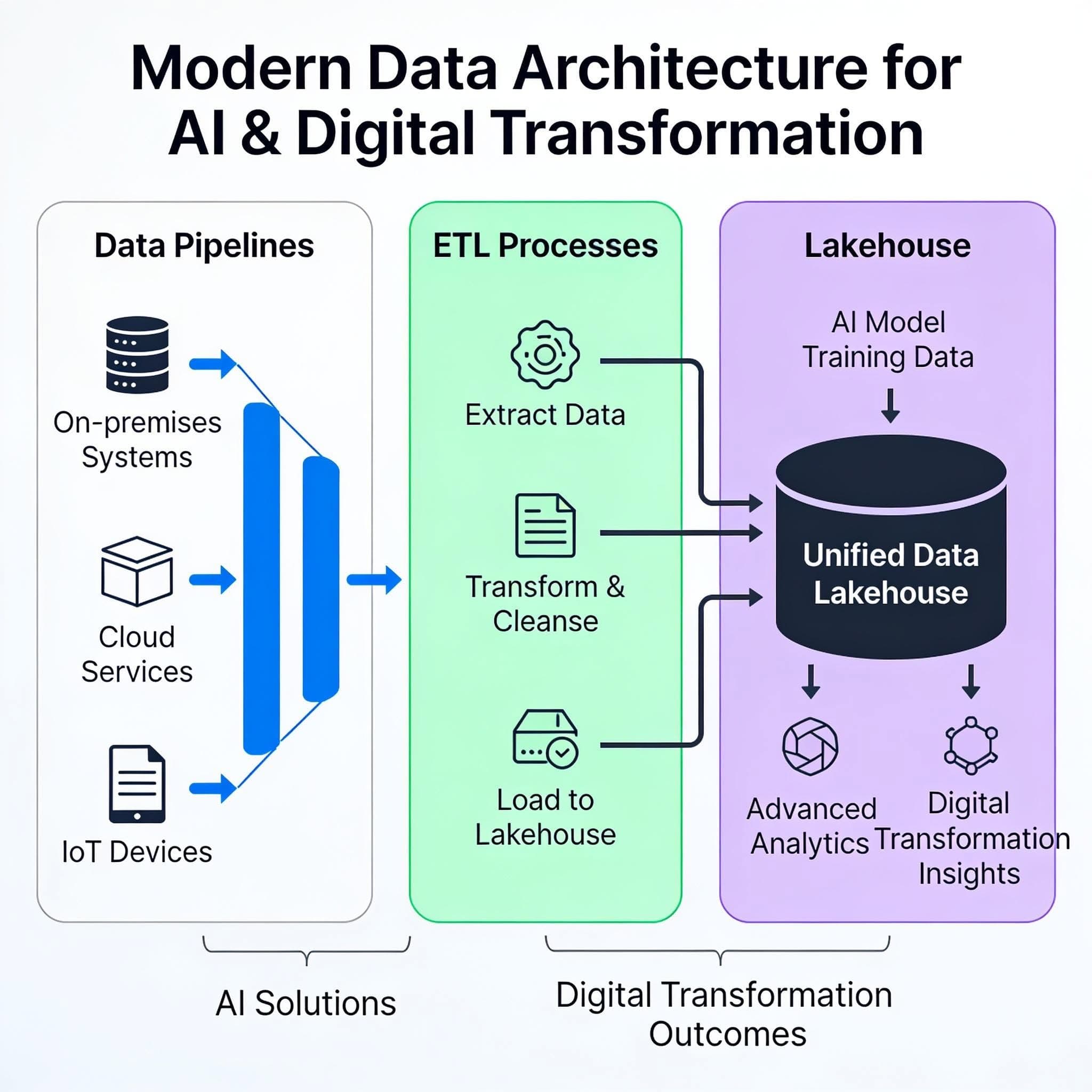
Learn how to design scalable data pipelines, implement ETL workflows, and leverage lakehouse architecture for enterprise analytics.
Introduction to Modern Data Architecture
In today's data-driven enterprise, traditional data warehouses often struggle to handle the velocity, variety, and volume of modern data streams. Combining raw data lakes with structured data warehouses has given rise to the Lakehouse Architecture—a unified pattern that provides reliability, ACID transactions, and high-performance querying directly on low-cost object storage.
Core Components of an Enterprise Data Pipeline
Building a modern ETL/ELT pipeline requires a modular stack tailored for speed and accuracy:
- Data Ingestion: Capturing batch and streaming data using modern connectors and CDC (Change Data Capture) mechanisms.
- Transformation & Modeling: Executing in-memory data modeling and SQL transformations before data reaches downstream analytics layers.
- Storage & Governance: Structuring data into open formats (Parquet, Iceberg, Delta Lake) with enforced schema validation and access policies.
Benefits of Data Lakehouse Architecture
Adopting a modern lakehouse architecture empowers organizations with key operational advantages:
- Unified Analytics: Run business intelligence reporting and machine learning workloads off the same underlying storage engine.
- Cost Efficiency: Decouple compute from storage to scale processing capacity independently as your data volume grows.
- Data Freshness: Reduce data pipeline latency from daily batch jobs to near real-time ingestion pipelines.
Building Scalable Pipelines with InforMityx
At InforMityx, we engineer enterprise data integration platforms that convert fragmented data silos into reliable, decision-ready analytics assets. From pipeline automation to cloud lakehouse migration, we help modern businesses scale their data operations seamlessly.