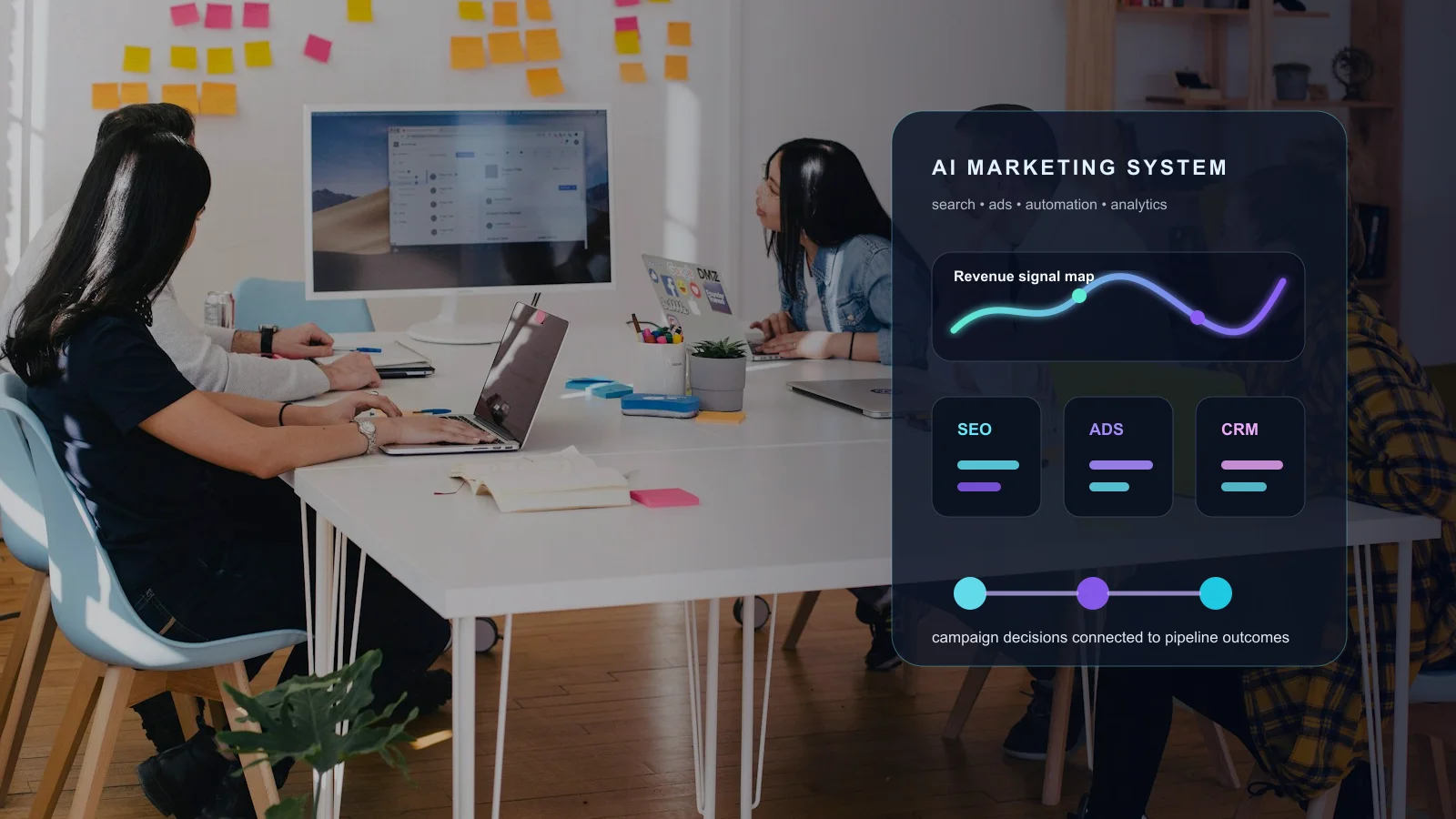
Learn how AI-powered digital marketing services connect SEO, paid media, websites, automation, and analytics into a measurable B2B growth system.
Digital marketing is no longer just a collection of campaigns. For B2B companies, it has become a growth system that connects search visibility, paid media, website performance, lead capture, automation, analytics, and sales follow-up. When those parts work separately, marketing becomes expensive and difficult to measure. When they work together, every click, landing page, form submission, and follow-up sequence becomes easier to improve.
That is where AI-powered digital marketing services create a practical advantage. The goal is not to replace strategy with automation. The goal is to use artificial intelligence, better data, and stronger execution to make marketing decisions faster, more measurable, and more aligned with revenue.
Why B2B digital marketing needs a system, not isolated campaigns
Many businesses invest in SEO, Google Ads, social media, landing pages, and email tools without a clear operating model. Traffic may increase, but the business still struggles to answer basic questions: which channels create qualified leads, which pages convert, which messages attract serious buyers, and which follow-ups move opportunities forward?
A stronger approach starts with the buyer journey. A potential customer may discover your company through an organic search, compare your services on a landing page, revisit through retargeting, read a case-style article, and finally submit an inquiry. If those touchpoints are disconnected, attribution becomes unclear and improvement becomes guesswork.
AI-powered digital marketing services help connect these touchpoints into one measurable system. Search content, ad campaigns, website UX, CRM data, and automation workflows can be reviewed together so decisions are based on behavior and outcomes, not assumptions.
The core keyword opportunity: AI-powered digital marketing services
The phrase AI-powered digital marketing services fits the direction of modern B2B demand because buyers are not only looking for more traffic. They want smarter execution. They want SEO strategies that respond to search intent, ad campaigns that improve based on performance signals, websites that convert visitors into leads, and automation that keeps prospects moving without manual follow-up gaps.
For an IT services provider like InforMityx, this keyword is also commercially relevant because it sits at the intersection of digital marketing, AI solution development, website development, analytics, and automation. It allows the business to speak to companies that need both marketing outcomes and technical implementation.
What an AI-powered marketing engine includes
A complete growth engine is built from several connected layers. Each layer should be simple enough to operate but strong enough to generate useful data.
- Search and SEO strategy: service pages, location pages, technical SEO, content clusters, internal linking, metadata, and schema that help search engines understand what the business offers.
- Conversion-focused website development: fast pages, clear service positioning, strong calls to action, accessible forms, and mobile-first layouts that reduce friction for visitors.
- Performance marketing: paid search, retargeting, landing pages, and campaign experiments managed around lead quality rather than vanity metrics.
- Marketing automation: inquiry notifications, lead routing, email follow-up, CRM updates, and workflow triggers that reduce response delays.
- Analytics and reporting: dashboards that connect traffic, campaigns, forms, calls, and pipeline data into decision-ready insight.
- AI-assisted optimization: faster research, content planning, audience segmentation, campaign diagnostics, and lead scoring support.
How AI improves SEO and content planning
AI can make SEO planning more disciplined when it is used with human review. It can help identify search themes, organize content clusters, compare page intent, summarize competitor positioning, and reveal gaps in existing service pages. The value is not in publishing generic articles at scale. The value is in building content that matches buyer intent and supports real services.
For example, a company offering website development, AI solution development, mobile apps, SEO, and performance marketing should not publish disconnected blog posts. It should build a content structure where service pages, location pages, insights, and FAQs reinforce each other. This improves topical relevance and helps visitors move from education to action.
How AI improves paid media and campaign efficiency
Paid media becomes more effective when campaign decisions are connected to conversion data. AI can help analyze search terms, identify weak landing pages, group audiences, summarize performance changes, and recommend experiments. But the system still needs clean tracking, strong landing pages, and clear lead qualification rules.
Without that foundation, automation can optimize toward the wrong outcome. With the right setup, performance marketing can shift from chasing clicks to improving cost per qualified inquiry, booked consultation rate, and sales pipeline contribution.
Why website development matters in digital marketing
Marketing performance depends heavily on the website. A slow page, confusing message, poor mobile layout, or weak form experience can waste traffic from both SEO and paid campaigns. This is why digital marketing should not be separated from web application and website development.
A strong website supports campaign performance through fast loading, clear page hierarchy, buyer-focused copy, service-specific landing pages, accessible forms, analytics events, and CMS-managed content. When the website is built as part of the marketing system, every campaign becomes easier to measure and improve.
Marketing automation closes the response gap
Many companies lose leads after the form submission. The visitor shows intent, but the internal response is slow or inconsistent. Marketing automation reduces that gap by notifying the right people, storing the inquiry, triggering follow-up steps, and keeping the prospect engaged.
Automation does not need to be complex at the beginning. Even simple workflows—instant owner notification, categorized inquiry data, CRM capture, and a structured follow-up message—can improve response quality. As the business grows, the system can expand into lead scoring, segmentation, nurture sequences, and lifecycle reporting.
What InforMityx brings to this work
InforMityx is positioned to support companies that need both strategy and implementation. The work can include website development, AI solution development, SEO, performance marketing, social media management, marketing automation, CMS-managed landing pages, analytics dashboards, and custom software integrations.
This matters because growth systems often fail between tools. A marketing agency may understand campaigns but not the technical architecture. A development team may build features but miss conversion strategy. A practical partner needs to connect both sides: the buyer journey and the technology required to support it.
A practical implementation roadmap
A focused AI-powered digital marketing engagement can start with a simple roadmap:
- Audit the current website and channels: review service pages, SEO structure, analytics, forms, campaign data, and content gaps.
- Define target services and markets: prioritize the offers, locations, and buyer segments that matter most.
- Build or improve landing pages: create pages for core services such as website development, AI solutions, mobile apps, SEO, performance marketing, and automation.
- Connect tracking and inquiry capture: make sure form submissions, calls, campaign sources, and page behavior are measurable.
- Launch focused campaigns: run SEO and paid media around high-intent service themes instead of scattered generic content.
- Use AI for analysis and iteration: review signals weekly, improve weak pages, update content, and refine campaign targeting.
The outcome: marketing that can be managed and improved
The best digital marketing system is not the one with the most tools. It is the one that the business can understand, manage, and improve. AI should make the system clearer, not more confusing. It should help teams identify what is working, where prospects are dropping off, and which next action is most likely to improve revenue.
For B2B companies, this approach creates a practical growth advantage. It improves discoverability, increases lead quality, shortens response time, and gives leadership better visibility into marketing performance.
If your business needs a digital marketing system that connects SEO, paid media, website development, AI, and automation, InforMityx can help design and build it around measurable growth.